I recently entered the Higgsfield Global Film Festival with my own short film created entirely with artificial intelligence. The festival is an international AI filmmaking competition with a total prize pool of $1 million.
The film is called THE DEADLINE, and in this article I’ll show you what it is about, which tools I used, how the production workflow was built, and what I learned along the way.
The concept: everyday marketing chaos turned into an action comedy
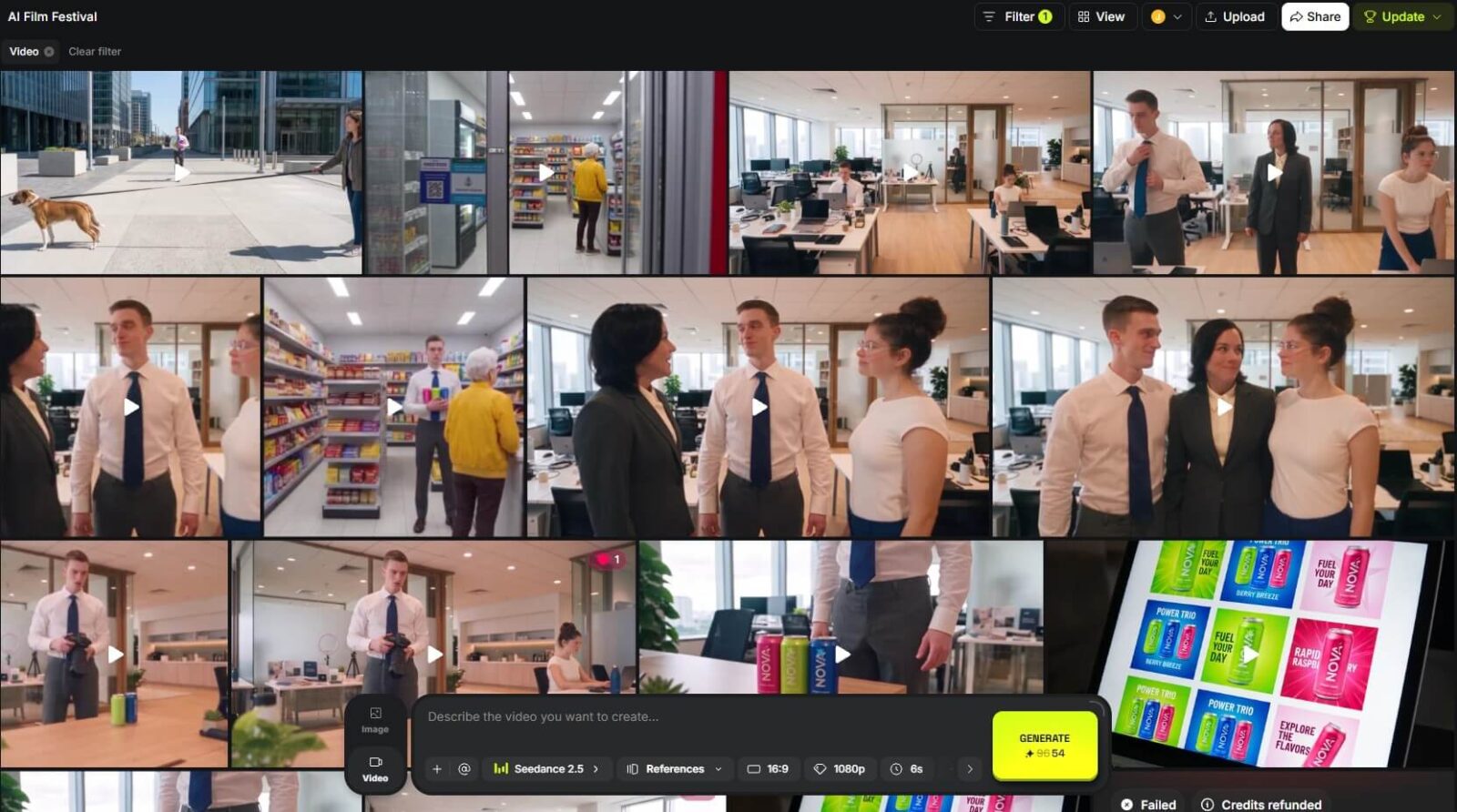
THE DEADLINE is best described as a corporate action comedy. A marketing team faces an all-too-familiar problem: there are only 30 minutes left until a campaign launch when the client asks for one more round of last-minute changes.
That’s where the chaos begins.
What starts as an ordinary office situation gradually turns into an exaggerated action movie: frantic running, locked doors, failed attempts to get what they need from local shops, an unbearably slow customer at the checkout – and finally, an unexpected twist.
The original idea was to take a situation that almost every marketer knows far too well and treat it with completely disproportionate cinematic seriousness.
Most of us have experienced that moment when a client asks for “just one tiny change” right before the deadline.
That contrast is exactly where the humour comes from: the film treats an everyday workplace problem as if it were a matter of life and death.
Watch the film
You can watch the full finished short film here:
The tools: an image-first AI video workflow
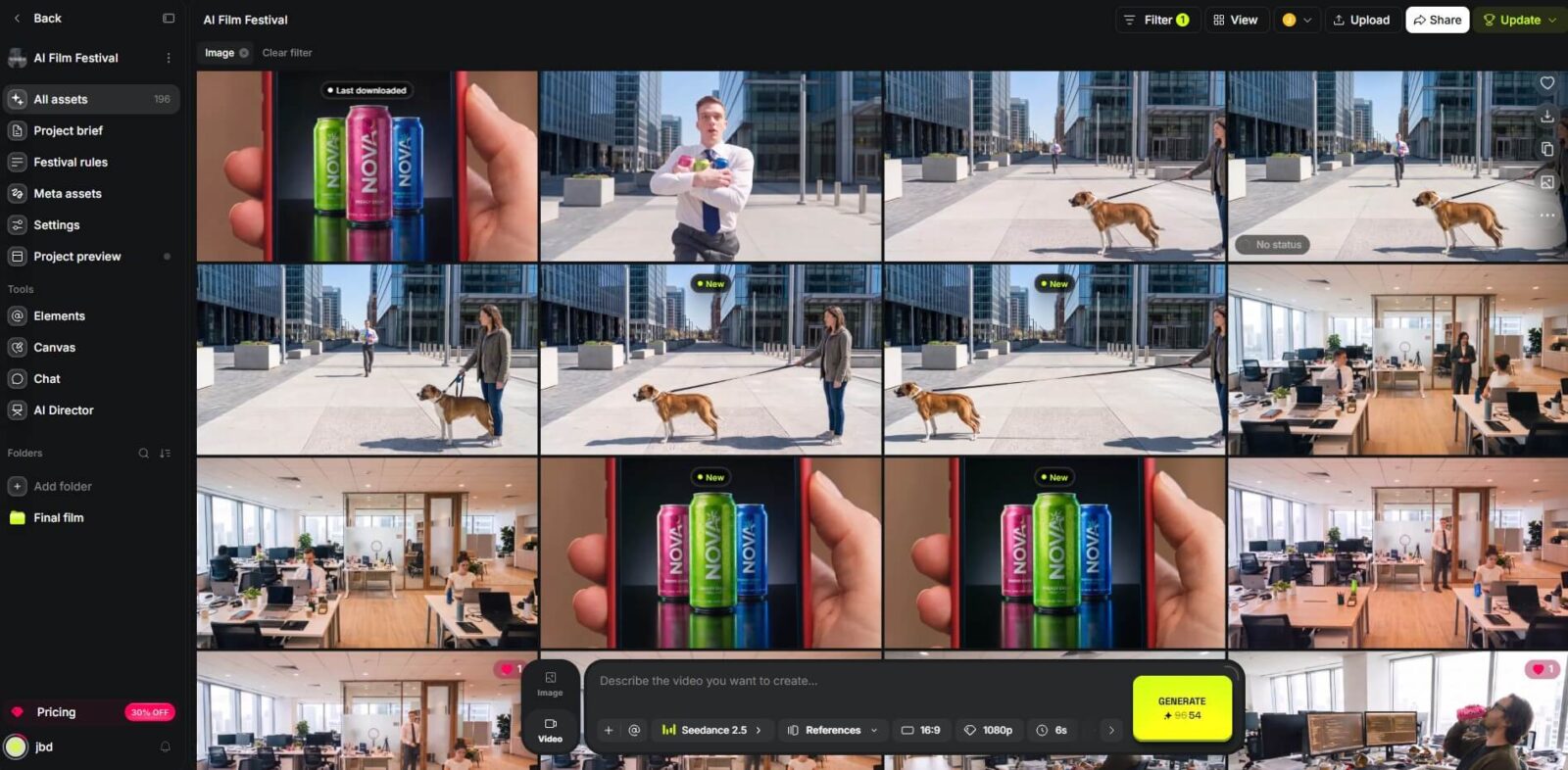
All of the AI-generated material for the film was created in Higgsfield Cinema Studio. This was also one of the festival requirements: every generation used in the entry had to originate from the Higgsfield project submitted to the competition. I then assembled the finished clips into the final film using external video editing software.
The workflow involved several tools:
- My brain: yes, I still believe this is the most important tool behind a good film. I kept creative control throughout the entire process. The concept, situations, dialogue and jokes all came from me. AI helped where something needed polishing or where an idea had to be translated into a technically effective prompt.
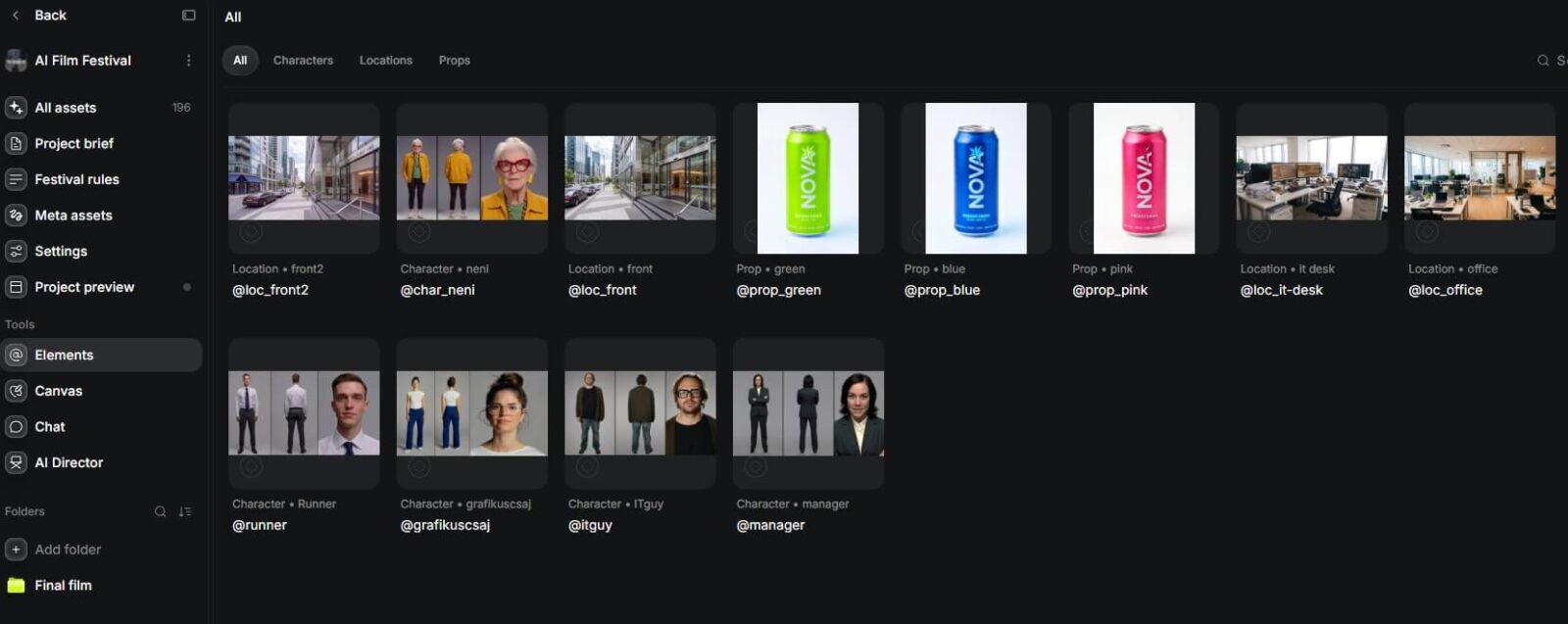
- Higgsfield Cinema Studio + Seedance 2.5: this formed the backbone of the actual video generation process. I created the characters, locations and product variations as reusable Elements, then referenced those Elements when generating individual scenes. Dialogue and ambient sound were also generated directly within the video clips.
- Google Gemini Pro: before defining the visual direction, I used Gemini to analyse the work of several AI video creators I admire, including their filmmaking techniques and prompting approaches.
- Kling: I tested Kling as a comparison on several scenes. In most cases, I ultimately stayed with Seedance 2.5 because it gave me more consistent characters and scenes for this particular project.
- Claude Cowork: I used Claude throughout the entire prompt-writing process. I gave it my raw scene ideas, and Claude turned them into final English-language prompts for Higgsfield. At the same time, it maintained an evolving production rulebook containing the lessons and mistakes from previous generations, so those could be taken into account in the next scenes.
That last part made a surprisingly big difference.
In a longer AI video project, it is very easy to make the same mistake again and again. When you record what you have learned along the way, each new scene can build on those previous lessons.okat menet közben rögzítjük, a következő jeleneteknél már ezekből lehet tovább dolgozni.
What I learned while making the film
During the project, I ran into several issues that initially seemed minor but ended up ruining quite a few generations.
Physical actions need to be described very precisely.
Opening a door or picking up an object seems completely obvious to a human. A video generator, however, often needs the action to be explained step by step. Otherwise, your character may happily walk straight through a piece of furniture, a door or even a shop window.
It is easy to overcomplicate prompts for short sound effects.
If you ask for too many events within a scene that lasts only a few seconds, the generator may try to fill the available duration by repeating them. The result can sound strangely repetitive. For short shots, one clearly defined sound effect often works better.
It is better to create distinctive characters through visual details.
Clothing, hairstyles, accessories and props are much more reliable ways to differentiate characters. If you try to overdefine things such as body type or age in text, the result can easily become distorted.
These may sound like small details, but a reliable AI video workflow is built from exactly this kind of practical experience.
AI would not have written this film like this without me
Perhaps this project demonstrated one thing particularly well: a strong result still needs human ideas, taste and creativity.
I came up with the story of THE DEADLINE. I created the situations, jokes, characters, their reactions and the overall tone of the film.
I went through many rounds of dialogue edits because the AI’s first versions were often too stiff, overexplained or simply too “AI-like”. I rewrote lines and added small reactions until the characters finally sounded like real people.
This is also why I think there is so much AI slop around.
Today, generating an impressive image or video is relatively easy. Making an enjoyable film takes much more: an idea, a sense of humour, rhythm, taste, countless small creative decisions and many rounds of refinement.
Those details still require time and energy, even when a scene is technically already “finished”.
Of course, the film still has imperfections. AI video generation is far from the point where every movement, face, object and continuity detail can be controlled perfectly.
For me, that was part of what made the project so interesting: seeing how far I could push the current technology by actively shaping every scene and refining it until I felt it worked.
Personal projects like this are a real creative playground for me. There is no client brief and no external approval process. Every creative decision is mine.
From the first idea to the story, the appearance of the characters and the smallest final joke, I get to shape the entire world myself.
The Higgsfield Global Film Festival
The Higgsfield Global Film Festival is an international AI filmmaking competition with a total prize pool of $1 million.
To enter, films must be created using the AI video generation tools available within the Higgsfield Cinema Studio platform.
You can view my project here: https://higgsfield.ai/@jbd/projects/the-deadline
The submission deadline is September 14, 2026.
For me, the competition was a great reason to complete a personal project that went beyond generating a single impressive AI scene.
I had to keep characters consistent, reuse locations, choreograph action, manage dialogue and sound, and then bring everything together into one coherent story.
Want to try Higgsfield yourself?
If you would like to create AI videos, commercials or even your own short film, you can try Higgsfield Cinema Studio here:
https://higgsfield.ai?fpr=edina96
This is an affiliate link. If you register or make a purchase through it, I may earn a commission at no additional cost to you. Using the link also helps support my work.
AI video production
THE DEADLINE was created as a personal portfolio project. I wanted to use a complete short film to test and demonstrate what a carefully designed AI video production workflow is capable of today, in autumn 2026.
If your company needs an AI-produced marketing video, product video or educational video content, take a look at my AI video production services and get in touch.